
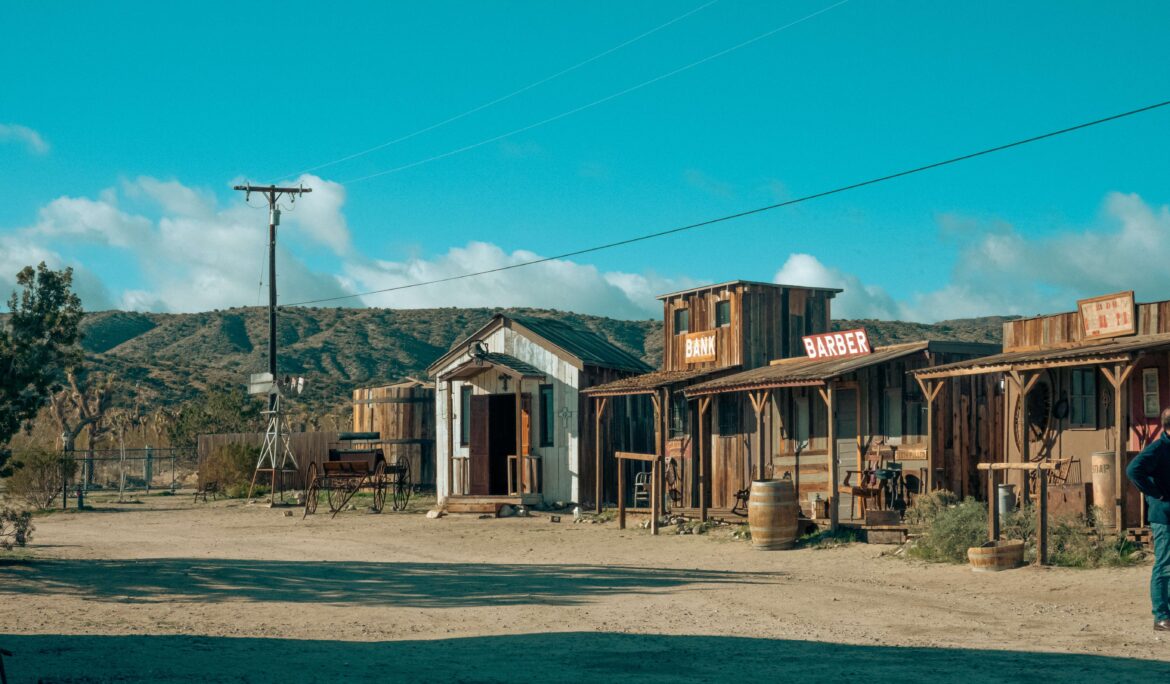
Hidden deep in a mountain forest, the No Name City film set was built as a full western town for a movie production in the late twentieth century. The location served a short cinematic role, then was abandoned, and later changed by time and environment, leaving only limited physical traces of its former presence.
Creation of the No Name City Film Set
The No Name City film set was constructed as a temporary settlement designed only for filming needs. It was not planned as a permanent town, museum, or tourist place. The builders focused on external appearance rather than long–term strength. Visual effect was the main goal.
The chosen location was a remote forest area with natural terrain and controlled access. This isolation helped production teams manage sound, lighting, and background scenery. The forest offered slopes, trees, and open clearings that matched the western theme without major landscape changes.
Construction involved fast methods and basic materials. Wooden frames formed building fronts. Many structures had shallow depth because only street–facing sides were visible on camera. Foundations were minimal, sometimes replaced by weighted bases or surface supports.
The town included streets, facades, and open areas designed for wide shots and movement scenes. Every part of the set followed camera logic, not real urban planning. The goal was illusion, not daily function.
Abandonment and Natural Transformation
Once the production team left, the No Name City film set entered a period of abandonment. No maintenance followed. Weather exposure began immediately. Rain weakened wood. Snow added weight to structures. Wind moved loose materials.
Over years, decay accelerated. Roofs collapsed first. Walls leaned and fell. Floors sank into soil. Plant life returned to cleared ground. Grass–covered streets. Trees grew near and through former building locations.
The forest did not preserve the town as a complete unit. Instead, the site fragmented. Individual elements disappeared at different speeds depending on material and position. Wood decayed faster than metal or concrete.
Today, the remaining evidence is scattered and incomplete. There is no clear boundary marking where the town once stood. Identification requires knowledge of construction patterns and unnatural ground features.
Typical physical traces visible today are
- Concrete blocks or brick pieces used as weights.
- Rusted metal rods and construction fragments.
- Flattened soil areas where buildings once stood.
- Clearings with unnatural shapes among dense trees.
These remains are not organized. They appear randomly, shaped by erosion and growth rather than human order.
Historical Context of Temporary Film Towns
The No Name City film set is from a time when big outdoor sets were common. Film companies often chose to shoot in real places instead of studios. This method aimed to increase realism and scale.
During this era, it was normal to build full towns for a single production. Budgets allowed large crews and long construction phases. Environmental impact was not a primary concern.
Such sets were rarely preserved. After filming, they lost economic value. Without a reuse plan, abandonment became the easiest solution. Nature then decided the future of these sites.
This practice created a unique type of historical trace. Unlike permanent towns, film sets existed briefly. Their remains do not follow traditional archaeological patterns. They reflect creative decisions instead of daily life needs.
The No Name City film set illustrates this process clearly. It shows how cultural production can leave material evidence without the intention to preserve it.
Cultural Meaning of the No Name City Location
The site has cultural importance even without official status. It represents a moment in cinema history when physical construction shaped storytelling. Before digital tools, realism depended on real space.
The location also connects media history with landscape history. A forest became a fictional town, then returned to its natural state. This cycle shows how human activity can be temporary, even when large in scale.
The set does not tell a story through buildings anymore. Instead, it tells a story through absence. Missing structures show how quickly things made by people can disappear without care.
The No Name City film set matters because it documents:
- Production methods of historical cinema periods.
- Interaction between temporary architecture and environment.
- The difference between cultural memory and physical survival.
Even in fragmented form, the site remains a reference point for understanding how film history once occupied real landscapes.
Current Condition and Lack of Protection
The No Name City film set has no formal protection or signage. It is not managed as a heritage site. There are no official records guiding visitors or researchers.
Because of this, the location continues to change naturally. Materials degrade further. Evidence becomes harder to identify each year. The forest slowly removes visible signs of filming activity.
This condition is in line with what was originally planned. The set was never meant to last. It makes sense that it would go away after it was made.
The No Name City film set is still there today, but it is not a preserved monument. Its worth is in how it is interpreted, not how complete it is.